
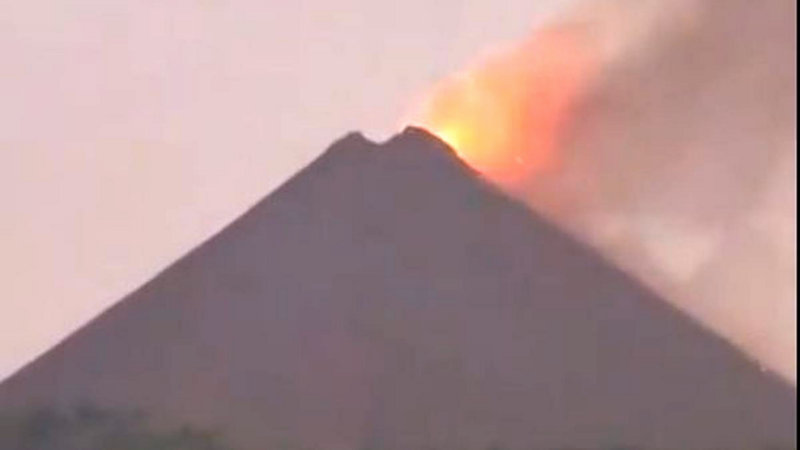
Barren Island, a remote volcanic landmass in the Andaman Sea, has once again made headlines after a series of minor eruptions on September 13 and 20, 2025. While these events may not have posed any danger to human life, they serve as an important reminder of the geological dynamism of the Andaman and Nicobar Islands. The island is home to India’s only active volcano, making it a crucial site for researchers, geologists, and environmentalists.
India’s Only Active Volcano Comes Alive
Located about 140 kilometers northeast of Port Blair, the capital of the Andaman and Nicobar Islands, Barren Island has long fascinated scientists. It forms part of a volcanic arc stretching from Sumatra to Myanmar, a belt shaped by the convergence of the Indian and Burmese tectonic plates.
The recent eruptions, although minor, were marked by small ash plumes and gentle lava flows. Officials have assured that the activity poses no immediate threat, as Barren Island remains uninhabited and off-limits to casual visitors.
The volcano has a documented history of sporadic eruptions. After lying dormant for nearly two centuries, it reawakened in 1991 in a dramatic event that captured global scientific interest. Since then, intermittent eruptions have been recorded, the most recent significant one occurring in 2022.
The Connection Between Earthquakes and Eruptions
Experts at the National Centre for Seismology (NCS) believe that the recent eruptions were linked to seismic activity in the region. Just two days before the September 20 eruption, a magnitude 4.2 earthquake struck the Andaman Sea.
This tremor may have disturbed the magma chamber beneath Barren Island, creating cracks and releasing built-up pressure. As a result, molten rock found its way to the surface in what geologists call a “premature magmatic eruption.”
This interaction between seismic activity and volcanic eruptions is common in tectonically active zones, and the Andaman arc provides a natural laboratory to study these processes.
A Living Laboratory for Geologists
While its name suggests desolation, Barren Island is anything but barren in scientific value. The stark volcanic cones, hardened lava fields, and recurring eruptions make it a living textbook for the study of plate tectonics, magma movement, and volcanic evolution.
Unlike many active volcanoes around the world that are located near populated regions, Barren Island offers scientists a risk-free environment for monitoring and research. Data collected here provides insights that extend beyond India, contributing to the global understanding of volcanology and seismic hazards.
Impact on Marine Ecosystems and Tourism
Though humans cannot live on the island, the surrounding waters are rich in marine biodiversity. Coral reefs, enriched by minerals from volcanic activity, thrive in this region. Advanced divers are often drawn to this unique ecosystem, where lava-formed landscapes meet vibrant underwater life.
Boat tours are permitted under strict regulations, allowing tourists to view the volcano from a safe distance. These controlled expeditions not only promote eco-tourism but also raise awareness of the natural wonders of the Andaman Sea.
Historical Background of Barren Island’s Eruptions
- 1787: The first recorded eruption of Barren Island.
- 1991: Major eruption after nearly 200 years of dormancy.
- 2005: Eruption coincided with the aftermath of the Indian Ocean earthquake and tsunami.
- 2017–2018: Multiple episodes of volcanic activity observed.
- 2022: Last significant eruption before the current 2025 events.
This historical timeline illustrates how volcanic activity is part of the natural rhythm of Barren Island.
Authorities on High Alert
The Geological Survey of India (GSI), along with the NCS, continuously monitors the island using satellite imagery, seismographs, and remote sensing technology. These agencies ensure that any escalation of volcanic activity is detected early, safeguarding not just researchers but also marine vessels navigating the Andaman waters.
Officials have emphasized that there is no risk to local communities or tourists since the island is uninhabited. However, the scientific community remains attentive, recognizing the potential of such activity to contribute to larger regional seismic shifts.
Why Barren Island Matters Globally
Barren Island’s significance extends beyond national boundaries. As the only active volcano in the Indian subcontinent, it plays a crucial role in global geoscientific studies. Monitoring its eruptions helps scientists compare volcanic behavior across different tectonic zones, contributing to international research on disaster prediction, climate impact, and marine geology.
Furthermore, the island embodies the delicate balance between natural hazards and natural beauty, reminding us of Earth’s power to both destroy and create.
Conclusion
The September 2025 eruptions at Barren Island may have been minor, but they hold major significance for scientists and nature enthusiasts. The island remains a geological sentinel in the Andaman Sea, providing a rare opportunity to study the interaction between tectonic forces, volcanic activity, and marine ecosystems.
As authorities continue their vigilance, Barren Island stands as a reminder that our planet is alive, dynamic, and ever-changing—a source of both awe and knowledge.
FAQ – Barren Island Volcanic Eruptions
Q1: Where is Barren Island located?
A1: Barren Island lies about 140 km northeast of Port Blair in the Andaman Sea, India.
Q2: Is Barren Island inhabited?
A2: No, the island is uninhabited, and landing there is strictly prohibited due to safety concerns.
Q3: When did Barren Island last erupt before 2025?
A3: The last notable eruption took place in 2022.
Q4: Why is Barren Island scientifically important?
A4: It is India’s only active volcano and offers valuable insights into plate tectonics, magma movement, and volcanic activity.
Q5: Can tourists visit Barren Island?
A5: Direct land visits are banned, but controlled boat tours allow tourists to view the volcano safely from the sea.


